For clients
Stretch ceilings – an excellent solution for modern interiors
A thin membrane stretched on profiles along the walls: it takes about 4 cm of height and usually one day of work. When it is a good choice, and when another ceiling suits you better.
For investors and interior owners considering a stretch ceiling who want to know what to expect from it.
A stretch ceiling is a thin, elastic membrane — PVC film or technical fabric — made to the dimensions of the room and stretched on profiles fixed around the perimeter, just below the existing slab. There is no grid across the whole surface and no tiles, so in a typical room the result is a single smooth surface without joints.
In Europe it is a separate product category with its own standard — EN 14716 “Stretched ceilings. Requirements and test methods”. That is worth knowing, because whether a ceiling performs well is decided by specific parameters in the membrane manufacturer’s declaration, not by general slogans.
How much height it takes — do the maths
A standard membrane without backlighting needs about 4 cm below the lowest point of the slab. A room that is 2.70 m high will be 2.66 m after installation — that is 4 / 270 ≈ 1.5% of the height. A ceiling backlit across its whole surface usually needs 15–20 cm so that the light spreads evenly; then 2.70 m becomes 2.50–2.55 m.
What counts is the lowest point, not the average. If the slab has a beam or a bulge that sits 3 cm lower, the profiles must be lowered by those 3 cm.
Where a stretch ceiling makes sense
Renovation without demolition work: a cracked, uneven or water-damaged slab disappears under the membrane without plastering or painting, and installation usually takes one day.
Low rooms where every centimetre counts.
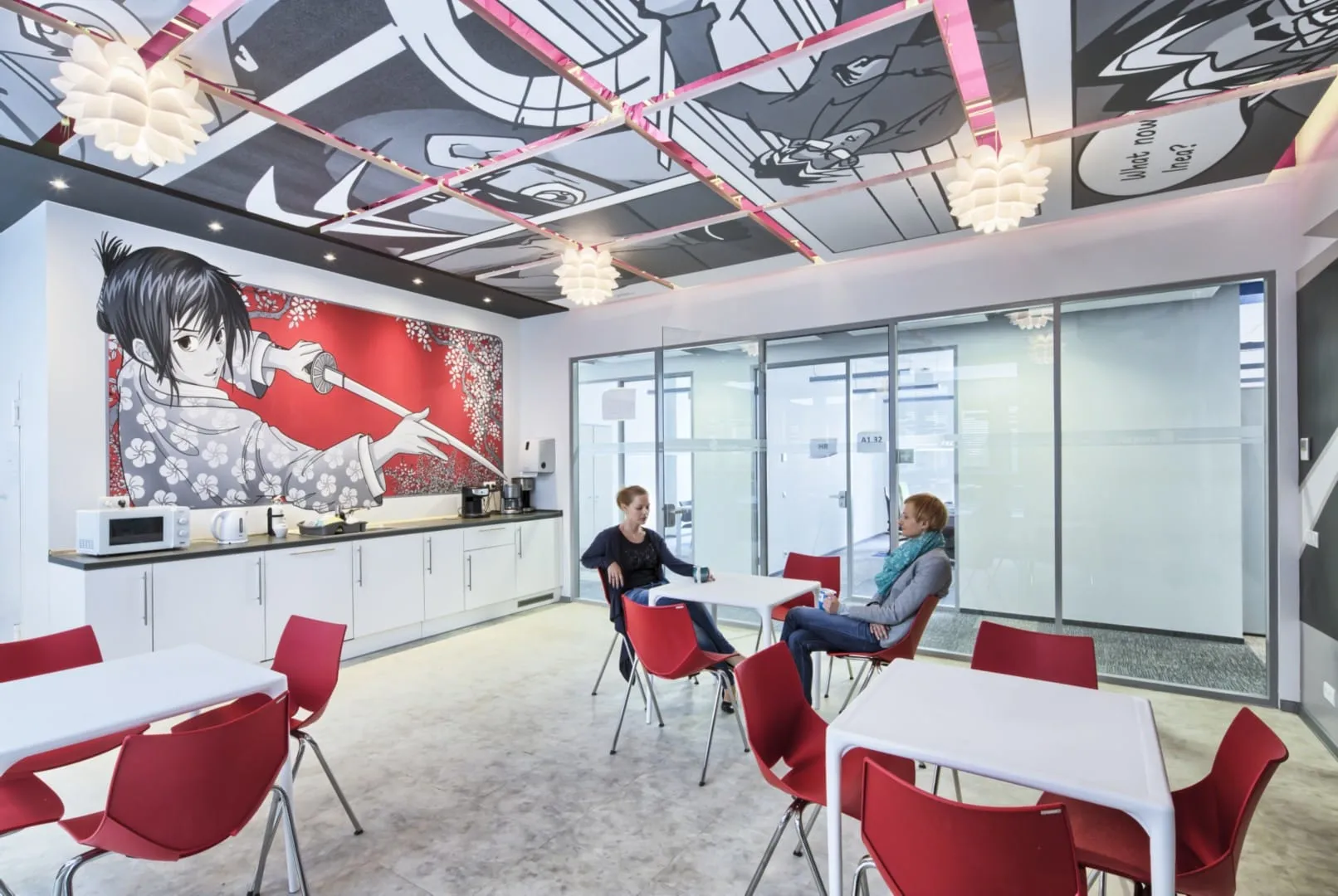
Interiors where the ceiling is meant to make an impression: gloss, print, backlighting, arches and three-dimensional forms.
Bathrooms and kitchens — the membrane copes well with moisture and needs no painting.
Where another ceiling is the better choice
When acoustics matter and the budget does not cover the micro-perforated version with wool. Smooth film has an NRC of around 0.05 — it reflects sound like plaster. Details in the article on the acoustics of stretch ceilings.
When there are services above the ceiling that need frequent access. Here a suspended ceiling made of tiles is more convenient, as every tile can be lifted out.
In the playing area of a sports hall — the membrane is not ball-impact resistant.
Frequently asked questions
How much does a stretch ceiling cost?
Our prices start at PLN 175/m² net. A 4 × 5 m room is 20 m², so the starting point is 20 × 175 = PLN 3,500 net; backlighting, printing, 3D forms and the number of light fittings raise the figure. We quote individually.
Is the installation messy?
Hardly. There is no sanding and no wet work; the only dust comes from drilling the holes for the profiles along the walls.
Can a stretch ceiling include lighting?
Yes — recessed fittings, LED lines or backlighting of the whole surface. However, the positions of the fittings and the cabling must be planned before installation, because the membrane closes off access to the slab. More in our stretch ceilings offer.