For clientsFor designers
Personalized stretch ceilings – ideal for every interior
Matte, satin, gloss, mirror or translucent — and how large a file must be for the print on the ceiling to come out sharp. With an example: how many pixels a 4 × 3 m ceiling needs.
For investors and designers who want a ceiling other than a plain white sheet — in color, with a gloss finish or with graphics.
A stretch ceiling is made to measure for a specific room, so you choose its look the way you would choose an upholstery fabric: type of surface, color and, if needed, a print. These three decisions are made before production — once the sheet is installed, none of them can be changed without replacing it.
Most disappointments come from printing: a graphic that looked sharp on screen can blur on a ceiling the size of a room. That is why, alongside the overview of finishes, we show a simple calculation of how many pixels the file needs.
Surface finish
Scroll horizontally to see all columns
Color
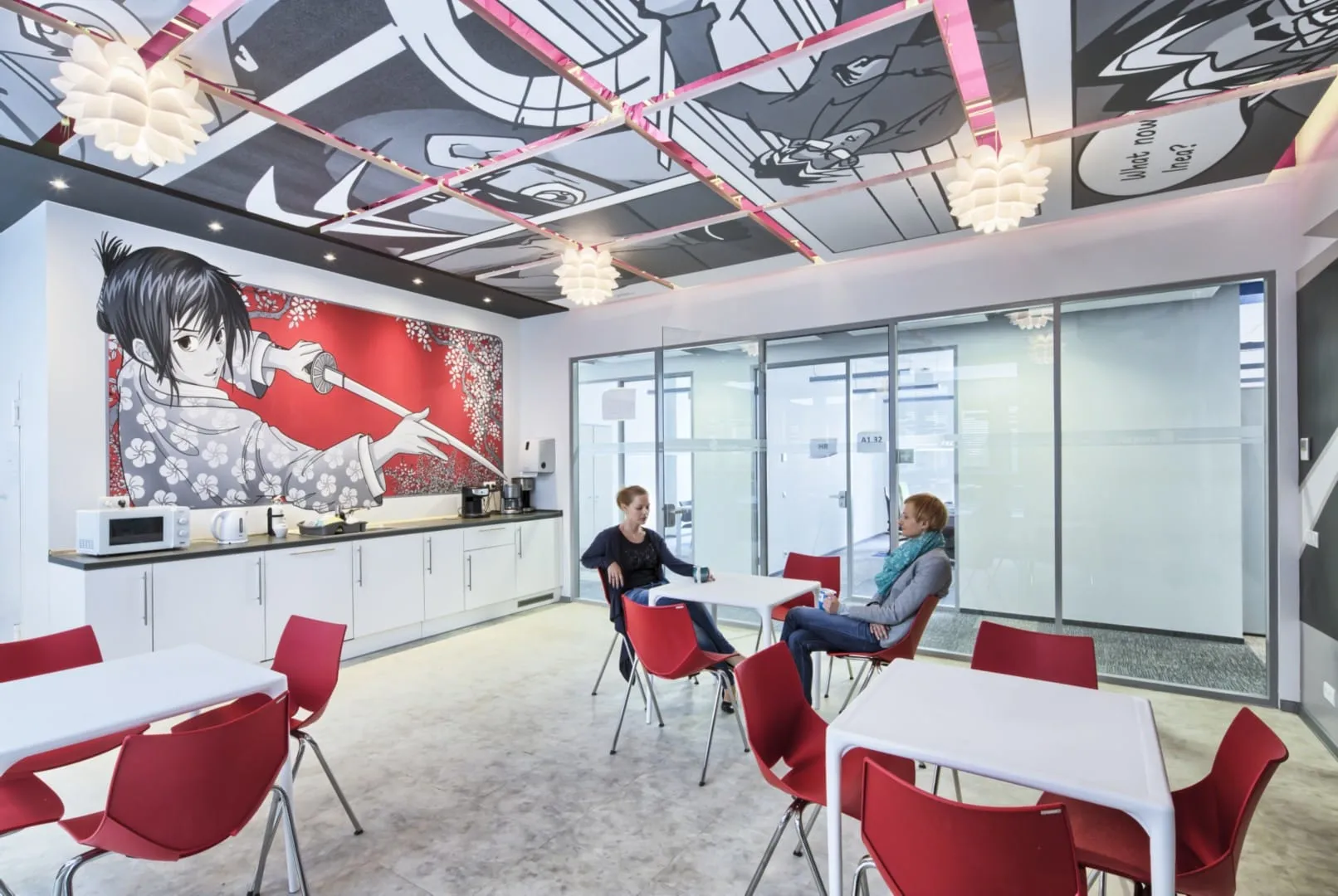
Membranes come in a wide palette of colors, and a single ceiling can consist of several sheets in different colors, separated by profiles. That is what we did in the offices in Polkowice, where three membrane colors were matched to the wall colors. It is worth choosing a color from a sample viewed in the final lighting, not on a screen.
Do the math: the print file
Large-format print shops match the resolution to the viewing distance: 300 dpi from half a meter, 200 dpi from 1 m, 150 dpi from 2 m, 40 dpi from 10 m. We usually look at a ceiling in a home from 1–3 m, so 150 dpi at 1:1 scale is a sensible target.
A 4 × 3 m ceiling is 4000 / 25.4 ≈ 157.5 inches by 3000 / 25.4 ≈ 118.1 inches. At 150 dpi that comes to about 23,600 × 17,700 pixels. For comparison, a 12 MP photo is 4000 × 3000 pixels — stretched across 4 m it gives 4000 / 157.5 ≈ 25 dpi, which is quality for viewing from 20 m. So a phone photo can cover part of a ceiling or a small coffer, but not a whole room.
Vector graphics (logo, pattern, lettering) scale without loss — the safest material.
Photo: a file at the resolution calculated as above, preferably PDF or TIF.
Colors in CMYK. The print shop will convert an RGB file, but then does not guarantee the shade — for important colors, ask for a test print.
Frequently asked questions
Can I supply a photo from my phone?
For a small element, yes. For a whole ceiling, usually not: a 12 MP photo stretched across 4 m comes to about 25 dpi, while from a typical distance you need about 150 dpi. A vector graphic or a high-resolution photo works better.
Will the color on the ceiling look like it does on my monitor?
Not always. A screen shows colors in RGB, print uses CMYK, and then there is the light in the room. For brand colors or photos, ordering a sample is worthwhile.
Which finish makes a room look taller?
Gloss and mirror, because they reflect the room. Keep in mind, though, that they also reflect fittings, cables and clutter — matte is the safer choice where the ceiling should stay neutral.