For designers
Modern technologies in stretch ceiling design
LED light lines, a backlit translucent membrane and three-dimensional forms — what each of these solutions demands of the design, how much height it takes, and how to calculate the light behind the membrane.
For architects and interior designers who want to build light into a stretch ceiling already at the concept stage.
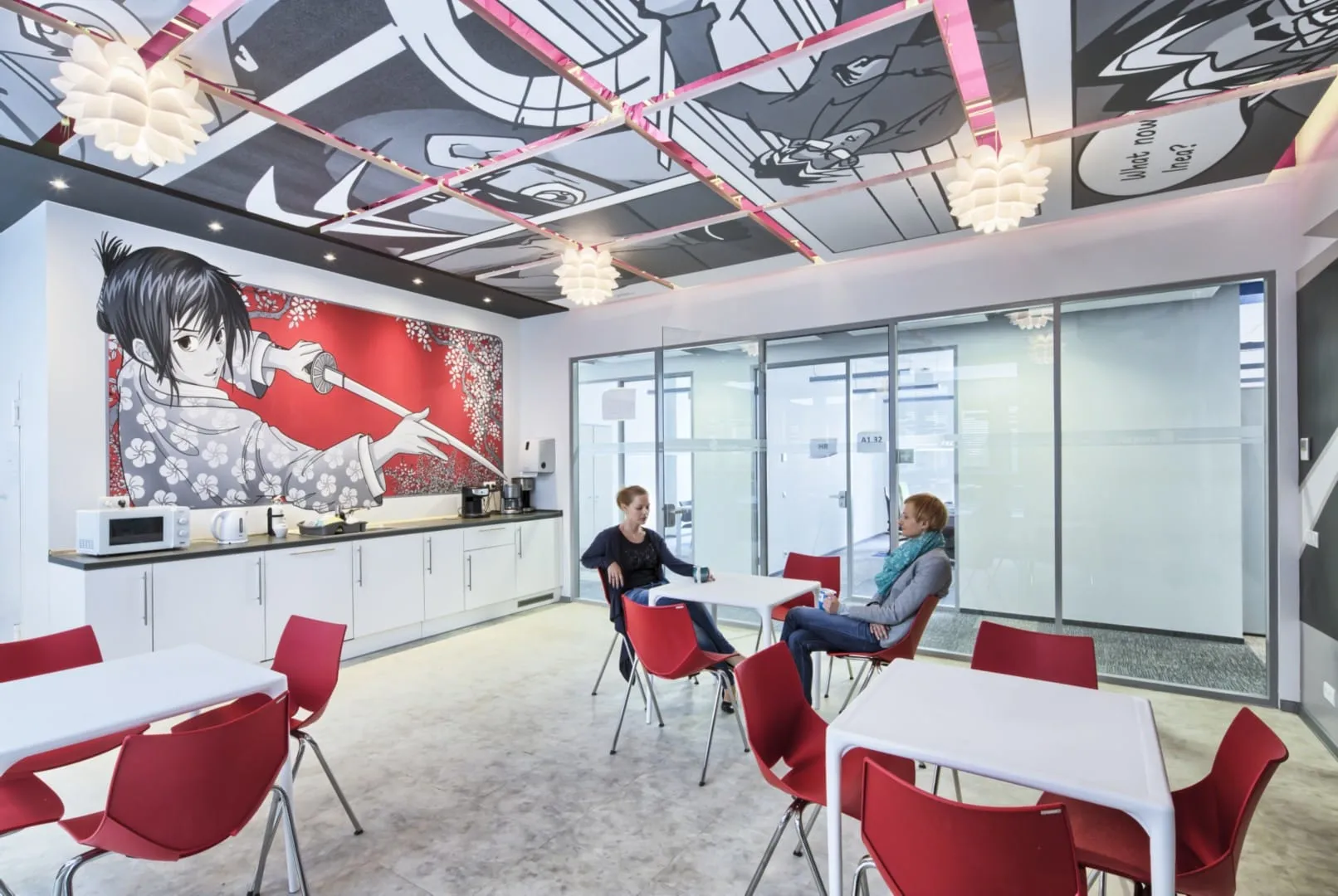
A smooth membrane on its own is just a backdrop. What stretch ceilings call “modern technology” boils down in practice to three things: light set into the surface, light behind the surface, and the shape of the surface. Each has its own requirements — above all regarding the height above the membrane.
It pays to know them before drawing the sections, because the difference is large: an ordinary membrane takes about 4 cm, a light ceiling usually 15–20 cm. That cannot be “added later” on site.
Three ways to bring in light
Spotlights set into the membrane — the simplest variant. Each fitting is an opening reinforced with a ring, so their positions are fixed before the sheet is manufactured.
LED light lines — narrow profiles that divide the membrane or run through it. They are routed exactly to the drawing: straight, angled, curved.
Translucent membrane lit from above — the entire surface glows evenly like one large ceiling light. It needs the most space and the most careful placement of the light sources.
Calculate it yourself: the light ceiling
A translucent membrane lets through only part of the light. For a white light ceiling, LED module suppliers recommend a material with a light transmission of at least 50%. This translates directly into output: if the room needs 5000 lm and the membrane passes 50%, the modules behind it must deliver 5000 / 0.5 = 10,000 lm.
The second rule concerns uniformity: the spacing of the LED rows should be roughly equal to the distance from the modules to the membrane. At a depth of 20 cm, a 3 m wide strip therefore needs about 3.0 / 0.2 = 15 rows; at 15 cm, already 20. The shallower the box, the more densely the modules must be laid out so that no stripes show on the ceiling. Module suppliers give as much as 30–50 cm of distance as the optimum; 15–20 cm is the realistic minimum, paid for with denser lighting.
Heat and servicing
The PVC film manufacturer states that its temperature should not exceed 50 °C — above that the film becomes too elastic. That is why sources that do not heat up, i.e. LED, are used above and in the membrane, and power supplies are placed outside the light box, in a spot with service access. A power supply enclosed above a sealed sheet becomes a problem at the first failure.
Three-dimensional forms
The membrane does not have to be flat: it is stretched on profiles routed in an arc, on several levels, or on a light structure that forms a volume. Such a “3D ceiling” is the shape of the structure, not a printing technique. A print can at most imitate depth; these are two different things and worth distinguishing in the project description.
Frequently asked questions
How much space does a backlit ceiling need above the membrane?
Usually 15–20 cm, so the light spreads evenly. An ordinary membrane without lighting needs about 4 cm. The less room there is, the more densely the LED modules have to be placed.
Can the lighting damage the membrane?
A source that heats up strongly can. PVC film should not warm above 50 °C, which is why LEDs are used in a stretch ceiling and the power supplies are routed outside the light box.
Can a light ceiling be seen in a completed project?
Yes — we used a milky translucent membrane in the footbridge of Brama Poznania, among others, and backlit ceilings at the centre in Śrem.
Sources
- SufmarTECH — “Stretch ceilings” service (installation heights, width without seam, welds)(opens in a new tab)
- Ledrise — Light ceiling with LED modules (transmission, module spacing and distance), 2023(opens in a new tab)
- Derflex — PVC Stretch Ceiling Film Q&A (permissible film temperature)(opens in a new tab)